We did (on our third day) go see the "Underground Army." We had already seen so many photos of the warriors that they weren't all that impressive. The first emperor of China had the army built in secret to defend him in the afterlife. There are over 6,000 warriors, although three-quarters of them still need to be excavated. They were originally vibrantly-coloured, but the paint fades quickly after excavation. Work continues (at night, when the tourists are gone) and they are making several attempts to preserve the original colours.
 We also visited a Wildlife Rescue and Breeding Research Centre to see some pandas. Pandas do not seem overly concerned with the extinction of the their species: the female is only fertile for a few days a year, pandas would rather hang out by themselves than mate, a mother will often club her baby to death, and will only nurture one of her cubs (leaving any others in a litter to die). After 20 years of trying, the Breeding Research Centre have only successfully bred two panda cubs - and both in the last four years. Hopefully, they're getting the hang of it now...
The panda cubs were very cute, and we were able to feed and pet them. Unfortunately, the rest of the 'Rescue Centre' was quite depressing. They had a cheetah (which had been kept drugged by a village), black bears (which had been milked for their bile) and numerous other sad animals. While these animals were being rescued from terrible situations, the rescue center seriously lacked financial support. Each animal was kept in a rather small cage, which consisting of only a concrete pad and steel bars instead of attempting to mimic the animal's natural habitat. We left the centre feeling really sad for the animals.
We spent the last few days that we were in Xi'an, actually seeing Xi'an. The city centre is surrounded by a 14km long (in perimeter) wall. The wall has a path along the top (about 5m across) that you can walk or bike around. We decided to bike the wall, so we rented a bike at the top and cruised around for a couple of hours. It was a really cool feeling to be cycling 15m above street level. If it weren't for the admission price for the wall and the fact that you can't bring your own bike to the top of the wall, it'd be a good commuting strategy for the locals...
Another key part of seeing Xi'an was the Muslim quarter. Unbeknownst to us, Xi'an has a sizeable population of Muslims (called Huis, who are descendents of Arabian merchants and travelers that came to the northwest of China by way of Persia and Afghanistan). The quarter consists of a bussling market area and street vendors, and so we spent a bit of time walking through it. We especially enjoyed the fried persimmons, the variety of dried fruits that you could buy (kiwi, tomatoes, oranges, etc.!) and the tasty halva!


 A few kilometers away from the section of the Great Wall we were going to, we could already see the wall snaking through the mountains. It was really exciting! At one point we could tell that the cab driver had no idea where he was going, but luckily he kept stopping and asking people in the nearby villages where we had to go. When we finally got to the wall, we were told by a guard that it was shut down...We were a bit disappointed as we assumed that we would have to ask the driver to take us to the more touristy sections. We were told however that we could head to a lake where we could hike and look at the wall.
 And as Mao once said, we are now "true men" (and women).
 Another thing is that we've left the places where we can attempt to blend in with the locals. Anytime you go anywhere touristy, you get asked if you want to buy guidebooks, Olympic paraphanalia, rickshaws rides, etc. What I think is particularly hilarious is that we've been approached a number of times by people who want to take their picture with us. We've even been handed someone's baby so that they could have their baby's picture taken with some gangly foreigners!
 Over the past few days we've seen quite a few of the sights as well, including Tiananmen Square, the Forbidden City (where the Chinese emperors used to live and was closed off from the public until the 1920s), the Temple of Heaven (a park with Buddhist temples), and Beihai Park (a huge park on a lake with an imperial garden and ponds with kai fish). We've also had the opportunity to climb a bit of the Great Wall, which we'll describe in the next post.
 As it turned out, the days flew by and we had a great time. We barely accomplished any of the planned reading or language practice and we slept less than expected, but we did eat most of the food. We had hoped for "authentic" Russian or Chinese people to share our compartment with (four bunks per compartment), but we were very pleased to spend the whole trip with a guy from Australia and a lady from New Zealand, each taking the slow way home. It turned out that "locals" in other cars would often fill their compartment with large bags, smoke filthy cigarettes, try to involve you in their smuggling operations and generally disregard hygiene.
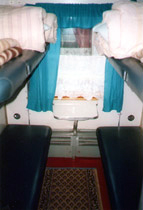 We chatted, played "Settlers of Catan - Travel Edition," wandered the train taking photos and generally just took it easy. We developed the concept of "segments of time." Rolling up the bedroll was one segment, breakfast was one segment, a "shower" in the cramped toilets would be a segment, and discussions ranging from vaccinations to politics to the Simpsons could range from 1-5 segments. The important thing was never to attempt too many things in one segment of time - just take things slowly and you'd be surprised how little you can accomplish in a day.
 Oh, and we got to see Siberia too. It was cold, rainy, sometimes snowy, and as uninhabitable as you would imagine. It felt great to sit in the warmth of our compartment, sipping tea and looking out on a bleak landscape. We also got to see the real level of poverty in Russia (state pensions are less than 100$ a month) which was not obvious in St. Petes or Moscow. Many elderly women have to supplement their income by growing their own food in small plots beside their sparse wooden shacks, and by selling home-cooked food to passengers on the passing trains.
 Luckily, the Metro is amazing, so we can get over all of these things. The Soviets were particularly proud of three things: the space program, the Trans-Siberian Railway and the Moscow Metro. The stations are decorated like palaces, with marble columns, colourful mosaics, stained-glass windows and chandeliers. And, they're deep enough that they could be used as nuclear fallout shelters (two minutes down on the escalator)...
 We visited St. Basil's cathedral (which had been our only mental picture of Moscow), Red Square and the Kremlin. Inside the Kremlin (which is just a Russia word for fortress), there are many more Russian Orthodox cathedrals and an impressive collection of royal jewels, gold, silver and Fabergé eggs (and our fake student cards got us in really cheap). The Fabergé eggs were incredible: fist-sized "Easter eggs" of hard stone, decorated with precious metals, with intricate jeweled 'trinkets' inside - including a five-carriage clockwork train.
 We also visited a GULAG museum. It was shockingly small and unknown, considering that it is the only museum dedicated to a system of forced labour camps that killed more than 2 million Russians. After having visited Auschwitz and other Nazi concentration camps, it was hard to believe that Stalin's crimes are being covered up so well.